Legal questions & knowledge base
Answers on the Code of Obligations, the Labour Act and collective agreements from a curated knowledge base, with official sources, a catalogue of collective agreements and verified minimum wages.
How long is the notice period during probation? When does a protection period begin? What is the difference between overtime and excess hours? Questions like these come up in SMEs every week, and the answers online often do not fit Swiss law or are out of date.
HREasy does not answer legal questions from a language model’s general knowledge but from a curated knowledge base. The knowledge base contains around 40 articles on contracts, termination, holidays, working hours, pay, parenthood and data protection. The 23 core articles in it are binding: the Copilot and the public chat must reproduce them faithfully, so that the answer does not depend on how the question was worded. On top of that come the catalogue of collective agreements, fixed minimum wage tables and a minimum wage check that only works with a source.
Sound familiar?
- For every legal question you search online and find German or outdated law.
- You are not sure whether a collective agreement applies to your company and what it requires.
- General AI chats answer confidently, but without a reliable source.
- An hour with a lawyer for an everyday question is out of all proportion.
Employment law, organised by topic
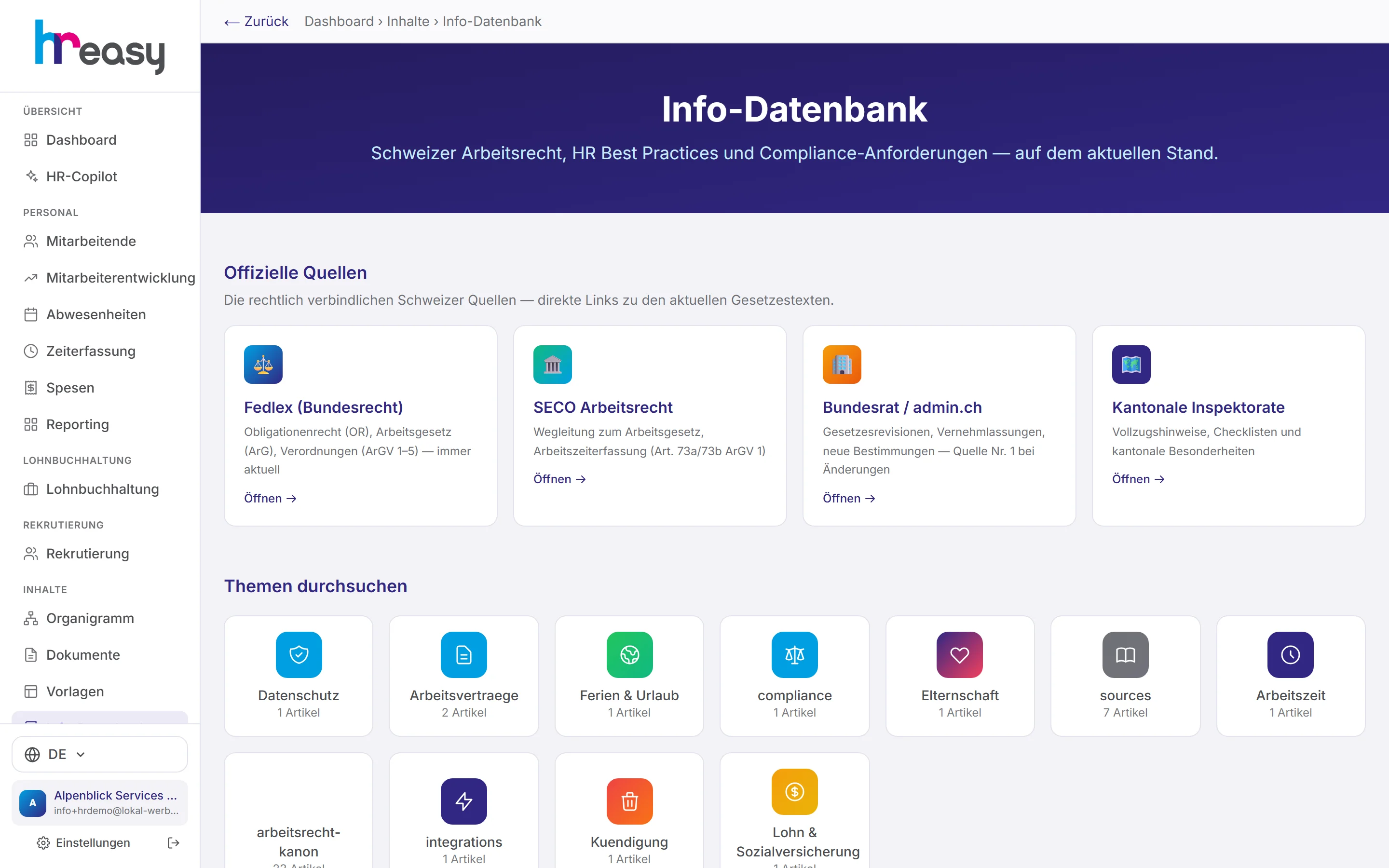
The knowledge base brings together what an SME needs to know in HR: employment contracts, termination, holidays and leave, working hours, pay and social insurance, parenthood and data protection. Each topic can be reached via a tile.
At the top are the official sources with direct links: Fedlex for the Code of Obligations, the Labour Act and its ordinances, SECO, the Federal Council and the cantonal labour inspectorates. HREasy maintains the articles; you do not have to keep anything up to date yourself.
- Around 40 articles, updated at every start
- Official sources linked directly
- The same curated basis for all companies
A fixed basis for every answer
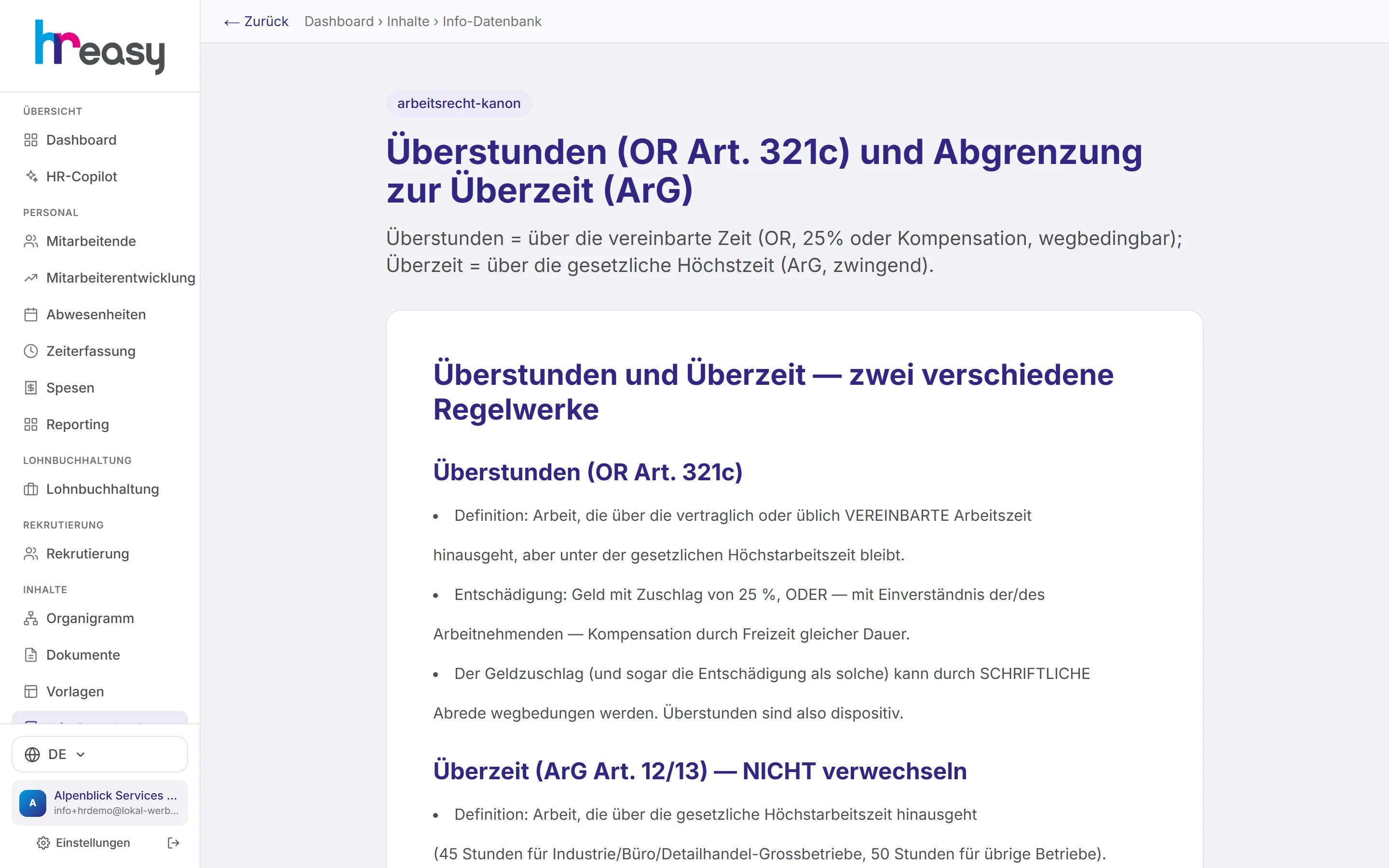
23 core articles cover the key questions of employment law: probation and notice periods, protection periods, continued pay, holidays, overtime and excess hours, breaks and rest periods, principles of collective agreements, non-competition clauses, BVG, mass redundancies, standard employment contracts, mandatory provisions and the national framework agreement for the construction industry.
When the Copilot or the public chat answers a legal question, it relies on these articles. So you get the same answer today and tomorrow, however you ask.
- Fixed legal facts, such as the 45/50-hour maximum working week and limits on excess hours
- Pregnancy and maternity: protection period, employment ban, 14 weeks of EO at 80 %
- Only official source links in the answers
Check minimum wages, but only with evidence
The catalogue contains 97 collective employment agreements, from industry agreements in construction, hospitality, manufacturing, retail, healthcare, cleaning and security to company agreements, each with a note on whether it is generally binding. It is used in the hiring assistant, the contract generator and the AI check.
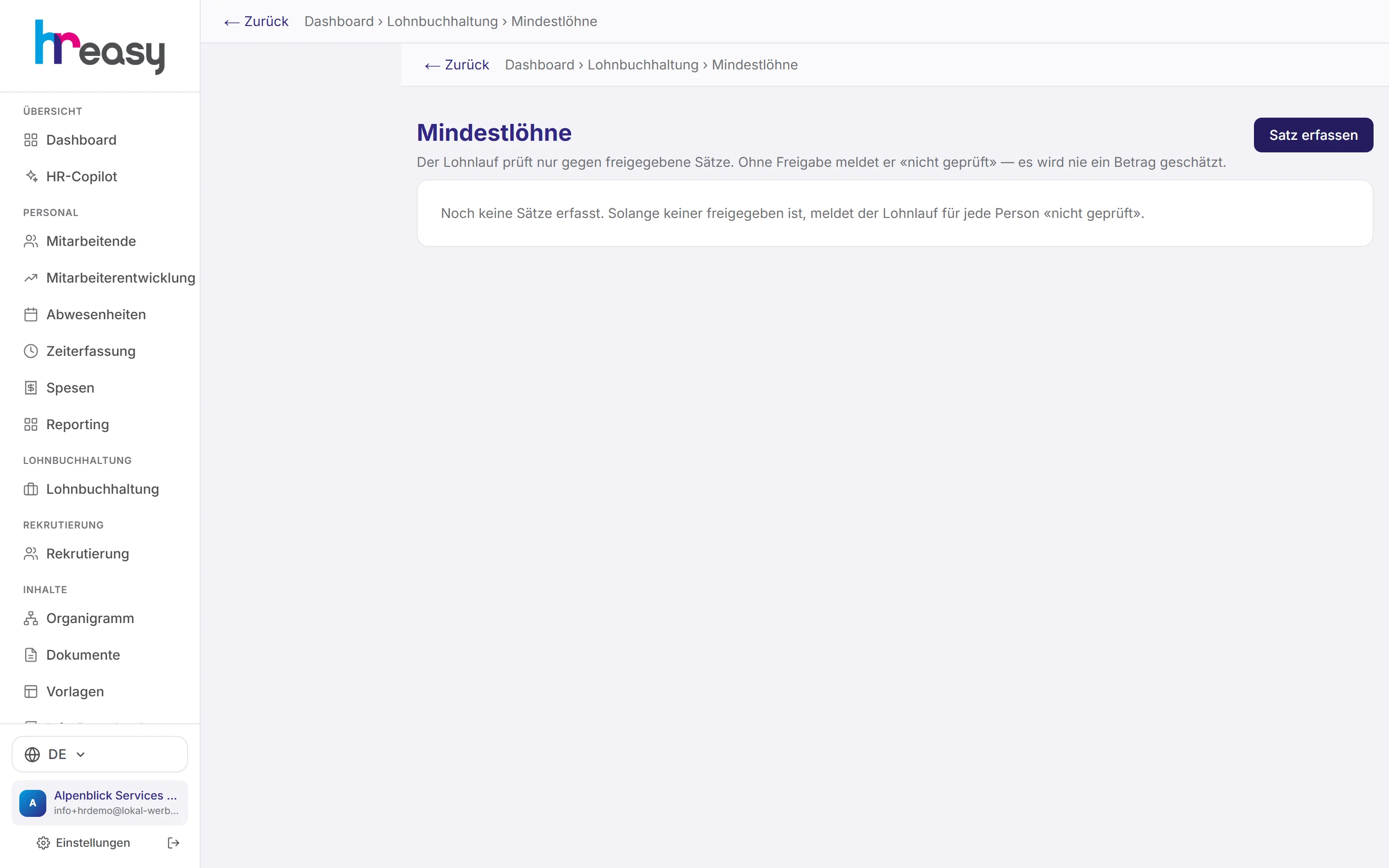
For the minimum wage check you record rates for the municipality, canton or collective agreement, each with a mandatory source link, and approve them. The payroll run only checks against approved rates. If one is missing, it reports «nicht geprüft» (not checked) and never estimates.
- Wage classes of 8 major collective agreements as fixed data (2026 values)
- Warning for rates older than 14 months
- Cantonal minimum wages of Geneva, Basel-Stadt, Neuchâtel, Jura and Ticino in the document check
How a legal answer is produced
Every answer follows the same order, so that it is right for your company and can be backed up.
Ask a question
In the Copilot, in the employee portal or in the public chat on the home page, in plain language.
Regulations first
Stored company regulations take precedence, provided they do not fall below the law.
Core articles and CEAs
The fixed core articles, the catalogue of collective agreements and the minimum wage data provide the legal basis.
Answer with source
Clearly worded, with the article and an official link; other links are removed.
Everything works together
No module stands alone. What you enter here flows automatically to wherever it is needed, without entering it twice.
What HREasy offers
Curated knowledge base
Around 40 articles on Swiss employment law, written by HREasy and updated at every start.
Binding core articles
23 articles on the key questions that AI answers must reproduce faithfully, so the information stays consistent.
Official sources
Fedlex, SECO, the Federal Council and cantonal inspectorates linked directly.
Official links only
Answers only link to Fedlex, SECO, the Federal Supreme Court and selected courts; other links are removed.
Catalogue of collective agreements
97 industry and company agreements with a note on general applicability, used in hiring, contracts and checks.
Minimum wages from collective agreements
Wage classes of eight major collective agreements as fixed data, so the AI does not invent amounts.
Minimum wage check with source
Rates for the municipality, canton or collective agreement only with a source link and approval; without a rate the result is «nicht geprüft» (not checked).
Company regulations
Uploaded regulations feed into the Copilot and the employee AI in full text and take precedence over the law.
Public chat
On the home page the agent answers general legal questions live, without logging in and without company data.
What you should know
Why a curated knowledge base
A language model can phrase employment law convincingly, but it can be wrong, mix up countries or quote outdated values. That is why HREasy does not answer legal questions from general knowledge but on the basis of the core articles.
The result: the same question leads to the same statement, and every statement can be traced back to an article and an official source.
Where a specialist still makes sense
The information is for everyday orientation and does not replace binding legal advice. In sensitive situations such as protection against dismissal, pay disputes or proceedings before the labour court, the agent explicitly recommends a specialist or the cantonal labour inspectorate.
This way you resolve the frequent questions yourself and bring in support where it really pays off.
Frequently asked questions
Who writes the articles in the knowledge base?
HREasy. The articles are maintained centrally and apply to all companies; you do not have to keep anything up to date yourself.
How does the AI know which collective agreement applies?
You select the industry or the collective agreement when hiring or when running a check. If this is missing, the Copilot asks before checking against an agreement.
How does the minimum wage check work?
You record rates for the municipality, canton or collective agreement with a source link and approve them. The payroll run only checks against these rates and otherwise reports «nicht geprüft» (not checked).
Do my own regulations apply?
Yes. Uploaded company regulations take precedence over the law in the Copilot and the employee AI, provided they do not fall below it.
Is this legal advice?
No. The answers are for general orientation and do not replace binding legal advice. The binding legal texts can be found on fedlex.admin.ch.
More modules
Ready to automate legal questions?
Set up in 5 minutes, no HR knowledge needed. The agent takes care of the rest.
Request trial access now